Updated: September 2026
I have been with The Safe Keeper for more than ten years. I run our Las Vegas location, and I supervise delivery and installation, which means I do not just sell these safes. I move them, bolt them down, service them, and occasionally I am the one who opens one after a house has burned.
That last part changed how I talk about fire ratings. There is a version of this article that just lists price brackets and tells you to look for a certification. You can find that version everywhere. What follows is what I actually walk customers through on the floor, including the parts that cost us a sale sometimes.
The short version: the word fireproof is meaningless, most fire ratings you will see are not independently verified, and the number that decides whether your documents survive has almost nothing to do with the big number on the sticker.

"Fireproof" Is Not a Real Category
Fireproof means either non flammable or able to withstand fire indefinitely. No residential gun safe is either.
What you are actually buying is a fire resistant container. It slows the transfer of heat into the interior for a stated period of time, at a stated exterior temperature. After that period, it stops working. That is not a flaw. That is the design.
So the honest framing is not "is this safe fireproof." It is "how long does this box hold the inside below a survivable temperature while the outside is on fire, and who says so."
Everything else in this article follows from that second half of the question.
The First Question to Ask: Who Ran the Test?
This is the part of the conversation that surprises people most, so I will be direct about it.
The large majority of residential gun safes on the market carry a fire rating the manufacturer gave themselves. The company built a furnace, put the safe in it, ran a thermocouple inside, and published the result. There is no independent lab, no published standard, and no third party auditing whether the next hundred safes off the line perform the same way.
That does not automatically make the number a lie. Some manufacturers run rigorous internal tests and stand behind them. But it does mean two ratings printed in the same font are not comparable, because they may not have been produced the same way, at the same temperature, with the thermocouple in the same place.
Here is what an independently verified rating looks like.
- UL 72 Class 350. Underwriters Laboratories runs the safe through a defined heat curve and confirms the interior never exceeds 350 degrees Fahrenheit for the rated duration, commonly a half hour, one hour, two hours or four hours. UL 72 also includes an explosion hazard test, where the safe goes into an already hot furnace to confirm it will not rupture, and for the longer classes an impact test I will come back to. UL also has Class 150 and Class 125 for media that cannot tolerate 350.
- ETL verified fire endurance. Intertek runs comparable testing and verifies the manufacturer's claim. You see this on gun safes more often than UL 72, because UL 72 is expensive and was written with commercial record protection in mind.
- Manufacturer tested. Everything else.
None of those three is disqualifying on its own. What matters is that you know which one you are looking at, and that you ask. My rule of thumb on the showroom floor: if a salesperson cannot tell you who ran the test within about ten seconds, the answer is the third category.
So the common advice, "look for a certification," is right but incomplete. Ask for the certifying body by name, and ask for the standard number. A real rating has both.
How to Read a Fire Rating, and the Number That Matters Most
A fire rating has three numbers in it, and buyers usually focus on the wrong one.
The exterior temperature. You will see figures like 1200, 1400 or 1680 degrees Fahrenheit. This is the furnace temperature the safe was exposed to. Bigger sounds better, and it does tell you something, but it is also the number marketing departments push hardest.
For context, a room fire that has reached flashover typically runs somewhere in the range of 1100 to 1800 degrees. So most of these exterior figures are in a realistic band. Where the number gets oversold is when a very high exterior temperature is paired with a very short duration.
The duration. Thirty minutes, sixty minutes, ninety minutes, two hours. This is the number I care about most, and I will explain why in a moment.
The interior temperature. This is the number almost nobody looks at, and it is the one that decides what comes out intact. UL Class 350 means the inside stayed under 350 degrees. If a rating does not state an interior temperature threshold, you do not actually know what the test was measuring.
Now, the duration question. People assume a fire is over when the fire department leaves. From the safe's point of view it is not. Here is the sequence I have seen play out.
The fire burns. The fire department arrives and knocks it down, and depending on the situation the active fire may run twenty to sixty minutes or more. Then the structure sits there, full of hot debris, smoldering. The safe has absorbed an enormous amount of heat into its steel and lining, and that heat keeps migrating inward. The interior of a safe often reaches its peak temperature well after the flames are out. It then takes many hours to cool, sometimes more than a day for a heavy safe.
That is why a thirty minute rating is thinner than it sounds. The clock that matters is not "how long was the fire," it is "how long until this box is genuinely cool," and that is a much longer number.
It is also why I tell people not to rush to open a safe after a fire. Opening it while it is still hot pulls oxygen and outside air onto contents that have been sitting in a sealed, superheated environment. Let it cool.
What a Fire Rating Actually Saves, and What It Does Not
This is the section I most wish somebody had written before I started doing this job, because it is where the sticker on the door stops being an abstraction.
UL chose 350 degrees for a reason: that is roughly the threshold below which paper survives. Paper begins to scorch and darken somewhere above that, and ignites in the range of 450 degrees. So a Class 350 safe is, by design, a document safe.
Now run everything else you own through that same 350 degree number.
- Documents, cash, passports, deeds, photographs. These are what the standard was built for. A verified Class 350 rating at an adequate duration protects them well. They may come out smelling like a campfire and slightly discolored. They will be readable.
- Firearms themselves. Steel is the most forgiving thing in the safe. Barrels and actions generally survive temperatures that destroy everything else in there. What does not survive well: wood stocks and their finishes, synthetic stocks, polymer frames on modern handguns, rubber recoil pads and grips, and any adhesive. Polymer frames start to deform well below the temperature that harms the slide sitting on top of them. Bluing and case coloring can discolor. So a rifle can come out mechanically sound and cosmetically finished, or come out with the metal fine and the stock gone.
- Optics. Scopes are sealed and nitrogen or argon purged. Heat compromises the seals and the adhesives holding lenses in place. A scope that looks fine after a fire may have lost its purge and will fog later. I tell people to treat post fire optics as suspect regardless of appearance.
- Ammunition. This is the one people ask about most and get the most conflicting answers on. Smokeless powder and primers begin to react in a range that is not far above 350 degrees. That is close enough to the protected threshold that I do not treat a fire safe as an ammunition storage solution, and I would not want a large quantity of it sealed inside a container with my documents. Store the bulk of it elsewhere, ideally in its original packaging, away from the safe.
- Hard drives, SSDs, USB sticks, phones. These die far below 350 degrees. This is exactly why UL publishes Class 150 and Class 125 for media. A Class 350 safe that perfectly protects your deed will cook your backup drive. If you are storing digital media, put it inside a small media rated box inside the gun safe. That nested approach costs very little and it is the single most common gap I see.
This is the distinction I would ask you to carry away from the whole article: a fire rating is a promise about one temperature, and your belongings do not all fail at the same temperature.
The Impact Test Is Not a Burglary Test
I want to correct something that circulates widely, including in earlier writing on this topic.
You will read that because UL fire testing includes an impact test, a fire rated safe is therefore tough against pry attacks. That is not what the impact test is for.
In the UL 72 impact test, the safe is heated and then dropped from roughly thirty feet onto rubble, then turned over and returned to the furnace to confirm it still holds temperature. It is simulating a floor collapsing during a fire and the safe falling to a lower level and then continuing to burn. It is a structural survivability test under fire conditions.
Burglary resistance is measured by a completely different family of standards, which assess how long a safe resists attack by a person with tools. Those are separate ratings, and a safe can hold a strong fire rating with a modest burglary rating or none at all, because the two goals pull against each other. Space inside a door filled with insulation is space not filled with steel.
Practically, this means you should ask for the fire rating and the burglary rating as two separate answers, in writing. If someone tells you the fire rating covers both, that is a sign to keep asking questions.
The one thing the impact test genuinely tells you is important though, and it leads directly into where you put the safe.
What Is Actually Inside a Budget Fire Safe
I have seen enough of these apart to have opinions. There are three broad approaches at the budget end.
Gypsum board layers. The most common budget approach, and it works better than its reputation. Gypsum contains chemically bound water. When it is heated, that water is driven off, and the energy consumed doing that is energy not going into the safe's interior. That is the entire mechanism.
Two consequences follow, and neither is usually explained to buyers. First, gypsum works by releasing moisture, so the interior of a fire safe gets humid during a fire, and it also means fire lining and standing water are a bad combination. Second, once the bound water is gone, that layer has spent itself. This is part of why duration is finite.
Ceramic wool or fiber blanket. Lighter than gypsum for comparable performance in some designs, often found paired with gypsum rather than replacing it.
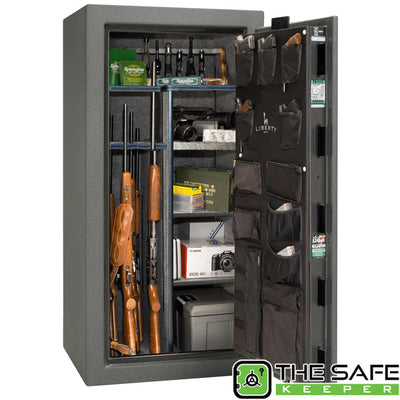
Composite or amalgamate fill. A poured, concrete like fire material that fills the body cavity. It performs better at sustained high temperatures and it is heavy, which is exactly why you see it as you move up in price. A comparable size safe can weigh dramatically more, and that weight is a real consideration for delivery and for the floor it sits on.
Beyond the fill material, look at the door seam. A heat activated intumescent seal around the door frame expands when temperatures climb, closing the gap against smoke and hot gas. In my experience smoke damage is underrated by buyers. A safe can keep the interior below 350 and still let smoke in through an unsealed door gap, and smoke deposits are corrosive on firearms and ruinous on documents.
When I am comparing two budget safes at the same price, the door seal and the door gap are often where the real difference is, not the headline temperature.
Where You Put It Decides Whether the Rating Means Anything
This is my job, so I will be blunt about it. I would rather install a moderately rated safe in the right place than a highly rated safe in the wrong one.
- Ground floor beats upper floor. Remember what the impact test is simulating. A heavy safe on a second floor during a structure fire is sitting on framing that is losing strength. If it goes through, it lands in whatever is below and then keeps cooking. If the safe must go upstairs, that is a conversation about floor loading before it is a conversation about fire.
- Interior beats garage. Garages often contain the vehicles, the fuel, the water heater and the stored chemicals, which is to say they are a common ignition point and they burn hot. They also swing the most in temperature day to day, which drives condensation and rust inside the safe long before any fire happens. If a garage is the only option, it is workable, but plan on a dehumidifier and a moisture barrier from day one.
- Away from the likely fuel load. Kitchens, laundry rooms, utility rooms with the furnace and water heater. Put distance between the safe and the places fires usually start.
- Level and anchored. A safe that sits slightly out of level because the slab pitches toward the drain does not close evenly into its door seal, and the corner that sits proud becomes the entry point for smoke and hot gas. We shim for this on every install. Anchoring matters for burglary, and it also keeps the safe upright if the structure around it starts moving.
None of this appears on a spec sheet, and all of it affects whether the spec sheet number is achievable in your house.
Sizing: The Mistake Almost Everyone Makes
Buy bigger than you need today. That advice is common and it is correct, but the usual reason given, "your collection will grow," is only half of it.
The reason I care about it is that fire safes get packed, and a packed safe stores more than firearms. Once someone owns one, the passports go in, then the hard drive, then the spare cash, then the jewelry, then the estate documents. Every one of those things has a different failure temperature, and a safe with no room left cannot accommodate a small media box or proper separation.
The counterweight is honest: fire rated capacity is expensive, because steel and fire lining both cost money and both scale with volume. Doubling interior capacity does not double the price, but it moves it meaningfully.
My practical guidance: rifle capacity ratings from manufacturers are optimistic, often assuming thin, scope free long guns packed perfectly. Assume you will fit somewhere around half to two thirds of the advertised rifle count once you have scopes and realistic stocks in there. Size from that number, not the box.
And consider the delivery path before you consider the capacity. I have had to turn around at a front door because the safe the customer chose could not make a stairwell turn. Measure the doorways, the turns and the stair width first. It constrains the decision more often than people expect.
What You Actually Get at Each Price Point
I am focusing on product categories and relative price tiers, while also including specific models as illustrative examples. Prices can vary over time, so treat these as approximate relative tiers rather than fixed price points.
- The bottom tier, roughly under 500 dollars. These are gun cabinets, not fire safes. Thin gauge steel, often no meaningful fire lining, and any fire claim is almost certainly self assigned with no standard behind it. They serve a real purpose, which is keeping firearms out of the hands of children and casual opportunists, and there is nothing wrong with buying one for that reason. Just buy it knowing it is a storage and access control product, not a fire product.
- Entry fire rated, roughly 500 to 1,500 dollars. This is where actual fire lining starts. Expect gypsum board, a claimed rating in the thirty to sixty minute range, usually manufacturer tested, and relatively light body steel. The honest tradeoff at this tier is that you are getting real but modest fire performance and modest burglary resistance. For someone protecting a few firearms and a folder of documents, this is a legitimate purchase.
- The practical sweet spot, roughly 1,500 to 4,000 dollars. In my experience this is where the value curve is steepest. You start seeing sixty to ninety minute ratings, noticeably heavier body construction, a proper intumescent door seal, better boltwork, and in some cases a third party verified rating rather than an in house one. If someone asks me where the money is best spent, this range is my answer more often than any other.
- Upper tier, roughly 4,000 dollars and up. Composite fire fill, two hour and longer ratings, genuine burglary ratings alongside the fire rating, and substantially more steel. The weight goes up sharply, which is not a small detail when we are installing it.
The thing I would push back on is the idea that you should stretch to the top of your budget on principle. You should not. You should match the safe to what you are protecting and to the realistic threats where you live. A very expensive safe installed in a bad location, with no dehumidifier and the hard drive sitting loose inside, is a worse outcome than a mid tier safe set up properly.
Best Fireproof Gun Safe For The Money
Cheap
And lastly, here we are with the most important question, “What is the best price-quality ratio for a fireproof gun safe?” To be honest, a fireproof gun safe under $500 is not worth considering at all. A cheap fireproof gun safe of a normal quality costs from $500 to $1500. However, you need to sacrifice either a beautiful interior design or capacity of the storage or sophisticated locking system or some of the security features for the price.
Affordable Price
An affordable fireproof gun safe which can probably meet all your requirements will cost you from $1,500 to $7,000. A good example of such safe is Fort Knox Protector 6031 Gun Safe. It has 1,680°F In 90 Minutes Fire Rating, enough spacious interior and luxurious exterior design. Not bad, isn't it?

Expensive
However, if you are ready to invest in one of the top fire rated gun safes, you need to have at least $8,000. It will no doubt pay you off. Just take a glance at Rhino Thunderbolt TIX7241 Ironworks Gun Safe. There is nothing to compare to it in terms of fire resistance, quality, security, convenience, endurance and capacity. But not everyone has this kind of money laying around.

Where I Tell People to Save, and Where I Do Not
Save on: interior finish and upholstery color, exterior styling and paint, door organizers and accessories you can add later, lighting kits, advertised rifle capacity beyond what you actually need, brand prestige.
Do not save on: the door seal, body steel thickness, the quality of the lock, and the install itself. Those four are difficult or impossible to upgrade after the fact without replacing the safe.
Spend a little extra on, because it is cheap relative to the safe: a dehumidifier, a small media rated box for digital storage, a hygrometer so you actually know the internal humidity, and proper anchoring. Together these usually cost a small fraction of the safe and they address the failure modes I see most often.
Frequently Asked Questions
Are fireproof gun safes really fireproof?
No. No residential gun safe is fireproof. They are fire resistant, meaning they keep the interior below a stated temperature for a stated duration when exposed to a stated exterior heat. After that duration the protection ends. The correct question is how long the safe holds and who verified it.
What is a good fire rating for a gun safe?
Look for at least sixty minutes, and prioritize the duration over the headline exterior temperature. Also check whether the rating states an interior temperature threshold, since UL Class 350 means the inside stayed below 350 degrees Fahrenheit. A rating with no interior threshold stated is not telling you much.
Are gun safe fire ratings independently tested?
Usually not. Most residential gun safe fire ratings are established by the manufacturer's own testing rather than by an independent laboratory. Independently verified ratings exist, most commonly UL 72 Class 350 and ETL verified fire endurance. Ask which one you are looking at and ask for the standard by name.
Does a fire rated safe also protect against burglars?
Not necessarily, and the two are measured by entirely separate standards. The impact test inside UL fire testing simulates a floor collapse during a fire, not a pry attack. Ask for the fire rating and the burglary rating as two separate answers.
Will ammunition be safe in a fireproof gun safe?
I do not recommend relying on it. Smokeless powder and primers begin to react at temperatures not far above the 350 degree threshold that fire ratings are built around. Store the bulk of your ammunition separately, in its original packaging, rather than sealed in the same container as your documents.
Can I keep a hard drive or USB drive in my gun safe?
Not directly. Digital media fails well below 350 degrees, which is why UL publishes Class 150 and Class 125 specifically for media. Put digital storage inside a small media rated container placed inside the gun safe. This is the most common protection gap I see.
How much should I spend on a budget fireproof gun safe?
Below roughly 500 dollars you are buying a gun cabinet rather than a fire safe. Real fire lining generally starts around 500 to 1,500 dollars, and in my experience the best balance of fire performance, steel and build quality sits in the 1,500 to 4,000 dollar range. Match the safe to what you are protecting rather than stretching to the top of your budget.
Does a fire rated safe protect against smoke?
Only if the door seals properly. A safe can hold the interior below 350 degrees and still admit smoke through the door gap. A heat activated intumescent seal around the door frame is what closes that gap. Smoke residue is corrosive on firearms and damaging to documents, so this matters more than most buyers realize.
Should I open my safe right after a fire?
No. The interior often reaches its peak temperature after the fire is out, and a heavy safe can take many hours or more than a day to cool. Opening it while hot exposes contents that have been sitting in a sealed superheated environment to fresh air. Let it cool, and have the safe evaluated, since fire lining that has been through a fire or through water should not be assumed to still perform.
Is a bigger fire safe always better?
No, but under sizing is the more common mistake. Fire rated capacity is genuinely expensive because steel and lining both scale with volume. Assume you will fit roughly half to two thirds of the advertised rifle count once scopes and real stocks are accounted for, and leave room for documents and a media box.
What I Tell Customers Before They Buy
If you remember four things from this, make it these.
Ask who ran the test and which standard it was run to. Prioritize duration over the headline temperature. Understand that 350 degrees protects your paperwork and destroys your hard drive, so plan for your contents individually. And think about where the safe is going before you think about which safe to buy, because placement can quietly undo a rating you paid a premium for.
The best budget fireproof gun safe is not the one with the biggest number on the sticker. It is the one whose rating you can actually verify, sized for what you own, installed somewhere a fire is less likely to start and a floor is not going to drop it into the basement.
I have opened safes after fires where everything inside was recoverable, and safes where the documents were perfect and the polymer frames were not. The difference was rarely what the customer spent. It was what they understood before they bought.