Gun Safe Maintenance: Tips to Keep Your Safe in Top Condition
- What Gun Safe Maintenance Actually Means
- Placement: The Decision That Creates Most Maintenance Problems
- Anchoring: Why an Unbolted Safe Wears Out Faster
- Humidity Control: The Advice Everyone Repeats and Gets Wrong
- Cleaning the Outside and the Inside
- Bolt Work, Hinges, and the Lubricant Mistake I See Most
- Fire Seals and Door Gaps
- Lock Care: Dials, Keypads, and Biometrics
- Troubleshooting: When Your Gun Safe Will Not Open
- What You Can Do Yourself and What Needs a Locksmith
- The Maintenance Schedule I Give Customers
- FAQ
- Final Thoughts
Updated: September 2026
I have been with The Safe Keeper for over a decade, and I run delivery and installation. That means I do not just sell safes in a showroom. I bolt them into concrete slabs in Henderson, carry them up staircases in Summerlin, open them when they stop opening, service the locks, and haul them away when they reach the end of their life.
Over thousands of jobs, the same failures keep showing up. Almost none of them are the failures you read about in generic maintenance checklists. Safes very rarely break because someone forgot to dust them. They break because of where they were put, how they were powered, what got sprayed into the lock, and what the owner did in the ninety seconds after the door stopped opening.
Here is what actually matters, based on what I see in real homes in Southern Nevada.

What Gun Safe Maintenance Actually Means
Gun safe maintenance is the small set of habits that keep three systems working: the environment inside the body, the mechanical door system, and the lock.
Everything else is cosmetics. A scratched paint finish annoys people, but it has never once caused a service call. A dead lock battery, a bound bolt carriage, or a safe sitting in a garage next to an evaporative cooler causes service calls constantly.
So when I talk about maintenance, I mean:
- Keeping the interior climate stable so steel, springs, and stored contents do not corrode.
- Keeping the door system moving freely so bolts retract without force.
- Keeping the lock powered, clean, and untouched by the wrong chemicals.
- Catching wear on the anchoring, seals, and handle before it becomes a lockout.
Placement: The Decision That Creates Most Maintenance Problems
If you want to cut your future maintenance to almost nothing, spend your effort here. Placement is permanent in practice, because once a 900 pound safe is anchored to a slab, nobody is moving it casually.
What I have learned to avoid:
Garages with evaporative coolers. This is the single most reliable rust generator I have seen in the Las Vegas valley. A swamp cooler pushes moist air into a hot garage. The safe body is a big cold mass of steel. Moisture condenses on it and inside it. I have opened safes in unconditioned garages where the exterior looked fine and the interior door panel was spotted with corrosion.
Against an uninsulated exterior wall. In summer the wall radiates heat, in winter it goes cold. That swing drives condensation cycles inside the body.
Inside the water heater closet or next to the laundry. People choose these because they are out of the way. They are also the two rooms in the house most likely to flood or run humid.
Directly on bare concrete in a room that floods. If you are in a low area or a converted garage, get the safe on a slab that drains away from it, or accept that the bottom edge will be the first thing to go.
What works: an interior closet or an interior wall in a conditioned room. Boring, dry, stable temperature, easy to reach for annual service. If a second floor location is structurally acceptable for the weight, it is often a better environment than the garage, though the weight question needs to be answered honestly before anyone starts carrying.
One thing I will add that most articles skip: think about service access at the same time. I have been called to safes wedged into corners so tight that I could not swing the door far enough to reach the lock body or the hinge side. That turns a twenty minute service into an hour of furniture moving.
Anchoring: Why an Unbolted Safe Wears Out Faster
Everyone frames anchoring as a burglary issue, and it is. Two people with a hand truck can walk an unbolted safe out of a house in a few minutes. But anchoring is also a maintenance issue, and that part almost never gets mentioned.
An unanchored safe rocks. Every time the door swings open, the mass of the door pulls the body forward. Over years, that repeated micro movement puts stress on the hinge side, works the body slightly out of square, and on lighter bodies it eventually shows up as a door that no longer closes as cleanly as it did. Add a full door organizer loaded with handguns and magazines and you are hanging real weight off that hinge line all day long.
Anchored safes stay square. Doors on anchored safes keep their alignment. I see this difference constantly when I go back to service a safe five or ten years after we delivered it.
Practical notes from installations:
- Most Southern Nevada homes sit on a concrete slab, which is the easiest and strongest anchoring situation. Wedge anchors into properly drilled and vacuumed holes hold extremely well.
- On wood framing, the anchor needs to catch structure, not just subfloor. Locating joists matters more than the hardware you buy.
- Use all the holes the manufacturer provided, not two of four.
- Re anchoring after a move is not optional. I have picked up plenty of safes where the previous anchor holes were simply left open after a relocation.
- Check the anchor bolts once a year. They can loosen, especially in the first year while the concrete and washers settle.
Humidity Control: The Advice Everyone Repeats and Gets Wrong
Every maintenance article says the same thing: put a dehumidifier in your safe. In a lot of the country that is right. In Las Vegas it is often wrong, and I say that as someone who sells dehumidifiers.
Our ambient indoor humidity here regularly sits in the teens. A conditioned interior closet in a Las Vegas home can run drier than the target range for stored firearms. Running a heated rod in that environment does not protect anything. What it does is dry out leather holsters and cases, stiffen rubber grips over time, and slowly degrade the intumescent fire seal around the door.
So the first step is not buying a dehumidifier. It is buying a cheap hygrometer, putting it inside the safe, closing the door, and reading it a week later. Measure before you medicate.
The target. Somewhere around 45 to 55 percent relative humidity is the range I aim for. Below roughly 30 percent you start affecting wood stocks, leather, and seals. Above roughly 60 percent you are into corrosion territory.
If you are genuinely too humid, a heated rod is usually the better tool than desiccant. It works by keeping the interior air slightly warmer than the surrounding room, which prevents condensation. Two things go wrong with rods in practice:
- People plug them into a switched outlet or a power strip that gets turned off, and the rod has been dead for two years without anyone noticing.
- The pass through hole for the cord gets stuffed with the cord and nothing else, leaving a small permanent gap. It is a fire rating compromise and an air leak. Seal it properly.
If you are too dry, do nothing. Remove the rod. Keep silicone treated gun socks off long term storage, because they can trap moisture against the metal rather than wicking it away, especially if a firearm goes into the sock still damp from cleaning.
Where the rust I actually see comes from. In my experience, the leading cause of rust inside a safe in this climate is not ambient humidity at all. It is a firearm that went back into the safe wet. Wet from a wipe down with a water based cleaner, wet from being carried in the rain on a hunt, or wet from a hand that was sweating on a summer range day. The safe is a sealed box. Whatever moisture goes in with the gun stays in with the gun.
The habit that prevents almost all of it: let firearms sit out and dry fully before they go back in, and wipe them down with a light oil or corrosion inhibiting cloth first. That single habit does more than any accessory you can buy.
Cleaning the Outside and the Inside
Cleaning matters less than the internet suggests, but it matters in specific places.
Exterior. A soft cloth and a mild cleaner is plenty. On gloss and metallic finishes, grit in a dry cloth is what causes swirl marks, so wipe rather than scrub. Chrome or brass hardware takes a light metal polish, but keep polish off painted panels.
The keypad and dial area. This is the part worth doing regularly. Fine dust builds up around a keypad and under a dial ring. Compressed air at low pressure and a dry brush is the right approach. Do not spray liquid cleaner at a keypad.
Interior. Vacuum with a brush attachment. Do not wet clean the interior fabric. That upholstery is typically glued to fiberboard, and water lifts the adhesive and warps the board. I have seen interiors sag and separate from a single enthusiastic cleaning with a damp rag.
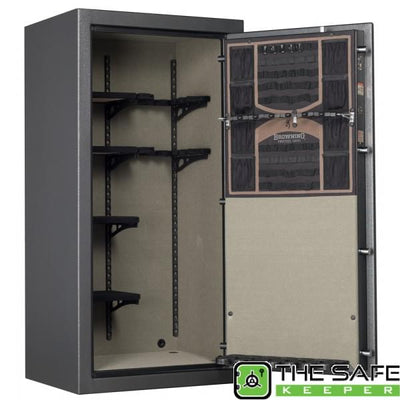
Door panel and organizers. Pull everything out twice a year. Vacuum the pockets. This is also when you should be looking at what you are storing: expired or corroded ammunition, old cleaning rags soaked in solvent that are quietly off gassing inside a sealed box, and paperwork that has been sitting on a damp shelf. I have opened safes where the corrosion source was a bag of old brass sitting in a bottom corner.
Bolt Work, Hinges, and the Lubricant Mistake I See Most
The door system is a set of sliding bars driven by a linkage. It wants to be clean and lightly lubricated, and that is all.
Here is the mistake I see on service calls more than any other: someone sprayed a penetrating oil into the safe. Penetrating sprays are solvents. They wash out the factory lubricant, run down into places that were supposed to stay dry, attract dust, and then dry into a gummy film. Safes I have opened years after a well intentioned spray down often move worse than safes nobody ever touched.
What I do instead:
- A very light film of white lithium grease or a quality dry film lubricant on the bolt shafts where they slide through the carriage. Light means light. Wipe off the excess.
- Nothing inside the lock body. Ever. Locks are designed to run dry, and lubricant inside a lock collects grit and causes exactly the failure people were trying to prevent.
- On external hinges, a small amount of grease at the pivot once a year. Internal hinges are enclosed and are not a user serviceable item.
- If the bolts require more force than they used to, that is a diagnostic signal, not a lubrication problem. Something is binding or out of adjustment. Adding grease masks it for a few weeks and then it comes back worse.
One more habit worth building: operate the door with the safe unlocked once in a while. Open it, retract and extend the bolts a few times, close it. Mechanisms that never move are the ones that seize.
Fire Seals and Door Gaps
The seal around the door edge is usually an intumescent strip that expands under heat to close the gap. It is the least glamorous component in the safe and one of the easiest to check.
Once a year, run your eye along the full perimeter. You are looking for cracking, sections that have pulled away from the channel, flattening, or gaps at the corners. Very dry environments make seals brittle over time, which is another reason not to run a heater rod in a home that is already dry.
There is a simple check for door fit. Close a sheet of paper in the door and pull. You should feel consistent resistance all the way around. If one section pulls out easily while the rest grips, the door is not seating evenly. That is worth having looked at.
Do not paint over a fire seal, and do not replace it with generic weather stripping from a hardware store. Weather stripping is not intumescent and does nothing in a fire.
Lock Care: Dials, Keypads, and Biometrics
Mechanical dials. A quality dial is the most maintenance free lock you can own. It has no battery, no electronics, and no failure mode caused by a power surge. I have serviced dials that were still running perfectly after thirty years. Two habits protect them: dial smoothly rather than spinning hard, and do not force the handle while dialing.
Electronic keypads. These are what most people buy now, and they are reliable when maintained. The failure mode is almost never the electronics. It is the battery.
What I actually find on lockout calls:
- A battery that died months ago and was ignored because the low battery warning is easy to miss.
- A leaking alkaline battery that corroded the contacts inside the keypad housing. This is the expensive one. A leaked battery can take the keypad with it.
- Bargain batteries, or a rechargeable or lithium cell used where the manufacturer specified alkaline. Voltage curves differ, and some locks behave unpredictably on the wrong chemistry.
My rule: replace the battery once a year on a fixed date whether it needs it or not, use a fresh name brand alkaline, and never leave a dead battery sitting in the housing. A 9 volt battery costs a few dollars. A locksmith visit does not.
Biometrics. Fingerprint readers are convenient and they are the least consistent lock type I deal with, particularly on smaller handgun safes. Dry desert skin, a cut finger, or a dusty sensor all reduce read reliability. If you rely on a biometric lock, enroll multiple fingers on both hands, keep the sensor clean, and make absolutely sure you know the backup access method before you need it.
Redundant locks. If your safe has both a keypad and a dial, exercise the one you do not normally use at least twice a year. A backup access method you have never tested is not a backup.
Troubleshooting: When Your Gun Safe Will Not Open
This is the situation that brings people to us, and the first two minutes matter enormously. What you do in that moment usually determines whether this is a twenty minute service call or a drilled door.
Step one: stop pulling on the handle. I cannot stress this enough. On most safes, side load on the handle puts pressure on the bolt work, which presses against the lock's blocking mechanism. A solenoid or a lever that is under load physically cannot move. People lean on the handle, punch the code, hear the beep, feel nothing happen, and lean harder. That is the loop that turns a dead battery into a real problem.
Correct sequence: let the handle return to its resting position, hands off, then enter the code, then turn the handle.
Work through this in order:
- Handle at rest, retry the code. Do not rush it. Enter it deliberately.
- Listen. No sound and no keypad lights means power. A beep and a click but no movement means the lock is working and something mechanical is not.
- Replace the battery. Use a fresh name brand alkaline, correct type. Many keypads hold the battery behind the keypad face. Some safes have an external battery compartment. Check your manual.
- Check the battery contacts. If you see white or green crust, that is a leak and the contacts need cleaning before anything else will work.
- Check for a lockout timer. Most electronic locks go into a penalty delay after several wrong entries. If you have been trying the code repeatedly, wait the full lockout period before trying again. Many "dead lock" calls are simply a lock in penalty mode.
- Check for an override. Some safes have a key override, often behind the logo plate or the dial cover. Know whether yours does before an emergency.
- Try the redundant lock if the safe has one.
What not to do, ever:
- Do not hammer the door, the handle, or the lock area. Nearly every safe has a relocker, a spring loaded pin designed to permanently lock the bolts if the safe is struck or attacked. Impact can trip it. Once a relocker drops, the safe cannot be opened without drilling, and that is a considerably larger job.
- Do not drill it yourself. There is hardplate over the critical areas, and drilling blind through hardplate almost always trips the relocker anyway.
- Do not pry at the door edge.
- Do not spray penetrating oil into the keypad or lock body.
When the keypad clicks but the bolts will not retract, it is usually one of three things: pressure on the handle, a bent or bound bolt linkage, or a slip clutch that has done its job and disengaged the handle to protect the mechanism. The first you can fix in five seconds. The other two need a technician.
What You Can Do Yourself and What Needs a Locksmith
Reasonable to do yourself:
- Battery replacement
- Combination changes on electronic locks, following the manual exactly
- Cleaning, vacuuming, and light bolt lubrication
- Visual seal inspection
- Re torquing anchor bolts
- Testing the backup access method
Call a safe technician for:
- Any safe that will not open after a fresh battery
- A dropped relocker
- Bolts that bind, grind, or require force
- A slip clutch that has disengaged
- Dial changes and dial service on mechanical locks
- A door that no longer seats evenly
- Any safe you want inspected after a move, a flood, or a fire
The value of an annual professional look is that a technician is checking things you cannot see with the door open: relocker condition, lock mounting screw torque, bolt travel and engagement depth, hinge wear, and the internal linkage. Those are the parts that fail quietly and then fail completely.
One honest note on cost. A scheduled service visit is inexpensive relative to an emergency opening, and dramatically cheaper than a drill and repair job on a locked safe. Most of the expensive work I do could have been a cheap visit six months earlier.
The Maintenance Schedule I Give Customers
Monthly, about two minutes
- Wipe exterior dust
- Blow dust from the keypad or dial
- Open and close the door, cycle the bolts
Every six months, about twenty minutes
- Empty the safe and vacuum the interior and door panel
- Check the hygrometer reading
- Inspect stored firearms for early corrosion spots
- Remove old ammunition, solvent soaked rags, and damp paperwork
- Light lubrication on the bolt shafts
- Test the backup access method
Annually, about an hour, plus a service visit
- Replace the lock battery on a fixed date
- Inspect the fire seal around the full perimeter
- Check and re torque anchor bolts
- Paper test the door seat
- Grease external hinge pivots
- Book a professional inspection of the lock, relocker, and bolt work
A safe treated this way is not a maintenance burden. It is a few minutes a month and one appointment a year, and it is the difference between a safe that works for thirty years and one that becomes a problem in five.
FAQ
How often should a gun safe be serviced professionally?
Once a year for most residential safes. Safes in garages, safes that get heavy daily use, and safes with biometric locks benefit from more frequent checks. If a safe has been moved, flooded, or exposed to fire or smoke, have it inspected regardless of when it was last serviced.
What humidity level should I keep inside my gun safe?
Roughly 45 to 55 percent relative humidity. Above about 60 percent you risk corrosion. Below about 30 percent you start drying out wood stocks, leather, and the fire seal. Measure with an inexpensive hygrometer inside the closed safe before adding any humidity control device.
Do I need a dehumidifier in a dry climate like Las Vegas?
Often no. Many conditioned interiors in Southern Nevada already sit below the target range, and adding a heated rod pushes the interior drier still. Measure first. If your safe is in a garage, near an evaporative cooler, or in an unconditioned space, the answer may be different.
What should I do if my gun safe will not open?
Take your hand off the handle completely, let it return to rest, and re enter the code. Then replace the battery with a fresh alkaline, check the battery contacts for corrosion, and wait out any lockout penalty period. Do not hammer, pry, or drill. Impact can trip the relocker and turn a simple fix into a drilling job.
How often should I change the battery in an electronic gun safe lock?
Once a year, on a set date, whether or not the lock has warned you. Use a fresh name brand alkaline of the type the manufacturer specifies. Never leave a dead battery in the housing, because leaking alkaline cells corrode contacts and can destroy the keypad.
Can I use WD 40 or penetrating oil on my gun safe?
No. Penetrating sprays are solvents that strip the factory lubricant, migrate into the lock, attract dust, and dry into a sticky film. Use a light film of white lithium grease or a dry film lubricant on the bolt shafts only, and keep all lubricant out of the lock body.
Why do my safe bolts feel stiff all of a sudden?
Stiffness is a symptom, not a lubrication issue. Common causes are pressure on the handle during entry, a bent or misaligned bolt linkage, an overloaded door organizer changing the door's alignment, or a safe that has shifted because it was never anchored. Have it looked at rather than forcing it.
How do I deal with rust that has already started inside the safe?
Address the source first, which is usually a firearm that went in damp or an unconditioned location. Remove everything, treat light surface rust on firearms with an appropriate oil and a non abrasive method, dry the interior fully, and check your humidity reading. If the safe body itself is corroding, have it inspected, because corrosion at the door edge affects how the door seats.
Does anchoring really affect maintenance, or only security?
Both. Anchoring is a major burglary deterrent, and it also keeps the body square. Unanchored safes rock slightly every time the door swings, which stresses the hinge side and gradually affects door alignment over the years.
Can I move my own gun safe?
Moving a safe is where most of the damage I repair originates. Tipped safes, dropped safes, damaged doors, cracked tile, and injured backs are all common. Safes are top heavy when the door is on, and a residential safe often weighs several hundred to well over a thousand pounds. Stairs and turns make it substantially harder. If the safe is worth protecting, it is worth having moved properly.
How long should a good gun safe last?
A well placed, anchored, and lightly maintained safe should outlast its owner. The safes I have retired early almost never died from age. They died from water, from a bad location, from an untouched dead battery that turned into a corroded keypad, or from a failed do it yourself move.
Final Thoughts
If you remember nothing else from this: measure the humidity before you try to control it, change the lock battery on a schedule, keep solvents away from the lock, anchor the safe properly, and never force a handle on a safe that is not opening.
I have handled thousands of safes across Las Vegas and Henderson, and the pattern is consistent. Safes almost never fail because their owners did too little cleaning. They fail because of a decision made on installation day, or because of something that got sprayed, forced, or ignored. Get those right and the safe becomes the most reliable thing in your house.
If you have a safe in Southern Nevada that is not opening the way it should, or you want an annual inspection done properly, that is what my team and I do every day.
Written by